

How to Verify If Your VPS Vendor Is Overselling CPU or Using Unlicensed Windows OS
The retail VPS industry is saturated with sub-$5/month hosting packages that survive on a singular, deeply deceptive business model: extreme resource overbooking and pirated software. When a provider sells a "2 Core" VPS at a fraction of the actual hardware's intrinsic operating cost, they are assigning ten or more virtual machines to the exact same physical CPU threads.
The hypervisor intentionally masks this 1:10 (or higher) oversell ratio, presenting an illusion of dedicated resources within your Windows task manager. The fatal consequence of this architecture is CPU Steal. During high-volatility events like NFP (Non-Farm Payrolls), thousands of EAs belonging to different users on the same physical host attempt to process dense tick storms simultaneously. Because the physical core is overbooked, the hypervisor forces your VM into a processing queue. This CPU Steal induces critical millisecond-delays in your EA's execution logic, which instantly translates into catastrophic slippage, degraded entry prices, and destroyed algorithmic edge.
Furthermore, ultra-cheap VPS hosts frequently cut costs by bypassing enterprise infrastructure licensing, silently loading cracked operating systems onto your trading machine. This is a literal backdoor to your equity.
1. Step-by-Step Hardware & Virtualization Audit
To expose the real hardware processing your trading algorithms, you cannot rely on the GUI Task Manager. You must interrogate the Windows Management Instrumentation (WMI).
Open an elevated Command Prompt (cmd) and execute the following:
wmic cpu get Name, MaxClockSpeed, CurrentClockSpeed
Diagnostic Analysis:
- The Model Check: Look at the
Nameoutput. If you see generic hypervisor tags like "Virtual CPU" or antiquated hardware like an "Intel Xeon E5" from 2014, your single-thread performance is already compromised. High-frequency EAs require modern, high-clock hardware. - The Clock Speed Anomaly: Compare
CurrentClockSpeedagainstMaxClockSpeed. If the current speed is heavily throttled or wildly fluctuating despite incoming terminal data, the hypervisor's governor is dynamically choking your resources to balance other "noisy neighbors" on the server.
2. Running the "CPU Steal" and Container Isolation Audit
Next, you must verify your container isolation level. Execute this command in your command prompt:
systeminfo
Scroll to the bottom of the output to the Hyper-V Requirements section.
If your VPS is running on LXC (Linux Containers) or OpenVZ, immediately migrate. These are OS-level virtualization methods where you share the exact same kernel with other users. It is highly unstable for memory-intensive trading software and offers zero hardware isolation.
Algorithm stability requires, at minimum, a true Kernel-based Virtual Machine (KVM) or Hyper-V environment, where RAM and CPU threads can be uniquely fenced off from the broader host.
3. The Genuine Windows License Threat (KMS Security Breaks)
In order to avoid paying Microsoft's enterprise licensing fees, budget VPS providers inject "KMS Activator" scripts—such as KMSAuto or massgrave—into the server image before deploying it to the customer. These crackers operate by installing an unauthorized local KMS (Key Management Service) emulator, often accompanied by persistent scheduled tasks that routinely inject activation payloads into the Windows kernel system at boot. This leaves an active, unpatchable backdoor inside your trading environment.
Threat actors routinely exploit these counterfeit KMS payloads to intercept clipboard data, scrape memory for MT4/MT5 credentials, and harvest private API keys or broker dashboard passwords en masse.
To query the true status of your Windows Software Licensing Service and detect automated KMS exploits, run these literal commands:
slmgr.vbs /dlv
This will trigger a dialogue box containing your detailed software licensing data.
- Look at the "Description" line. If it says
VOLUME_KMSCLIENT channel, and you did not purchase this VPS through an enterprise corporate contract, you are on a cracked server. A legitimate retail/individual deployment often reads asRetail channel. - Look at the "KMS machine name from DNS". If this points to an obscure IP address,
127.0.0.1, or a sketchy domain name, your VPS is communicating with an illegitimate key-foraging server.
Next, verify the expiration permanence:
slmgr.vbs /xpr
If the prompt states "Volume activation will expire [Date]", the server is utilizing an illegal rotating KMS crack. Genuine, permanently activated Windows Server OS licenses purchased legally by a compliant hosting firm will explicitly state: "The machine is permanently activated."
The Zero-Compromise Solution: MyFXVPS Architecture
You should not have to spend hours auditing your host's virtualization layer or worrying if system-level malware is passively recording your MetaTrader passwords. Security and isolation at the hardware level are prerequisites for algorithmic trading.
At MyFXVPS, we operate under total corporate compliance and zero-compromise architectural standards:
- Genuine OS Integrity: We utilize strictly legal, permanently licensed, and native Windows Server builds. No KMS cracks, no activation scripts, and zero backdoor vectors.
- Flagship Zen 5 Power: Our infrastructure is forged entirely from bare-metal AMD Ryzen 9 9950X (5.7GHz) and bleeding-edge AMD EPYC server hardware, natively crushing tick data calculations faster than legacy Xeon arrays.
- True 1:1 Hardware Division: We deploy strict 1:1 core isolation. When you rent processing power with us, you are given a dedicated physical thread mapped exclusively to your VM via KVM. We engineer zero CPU-Steal. Zero overbooking. Zero queueing during NFP data storms.
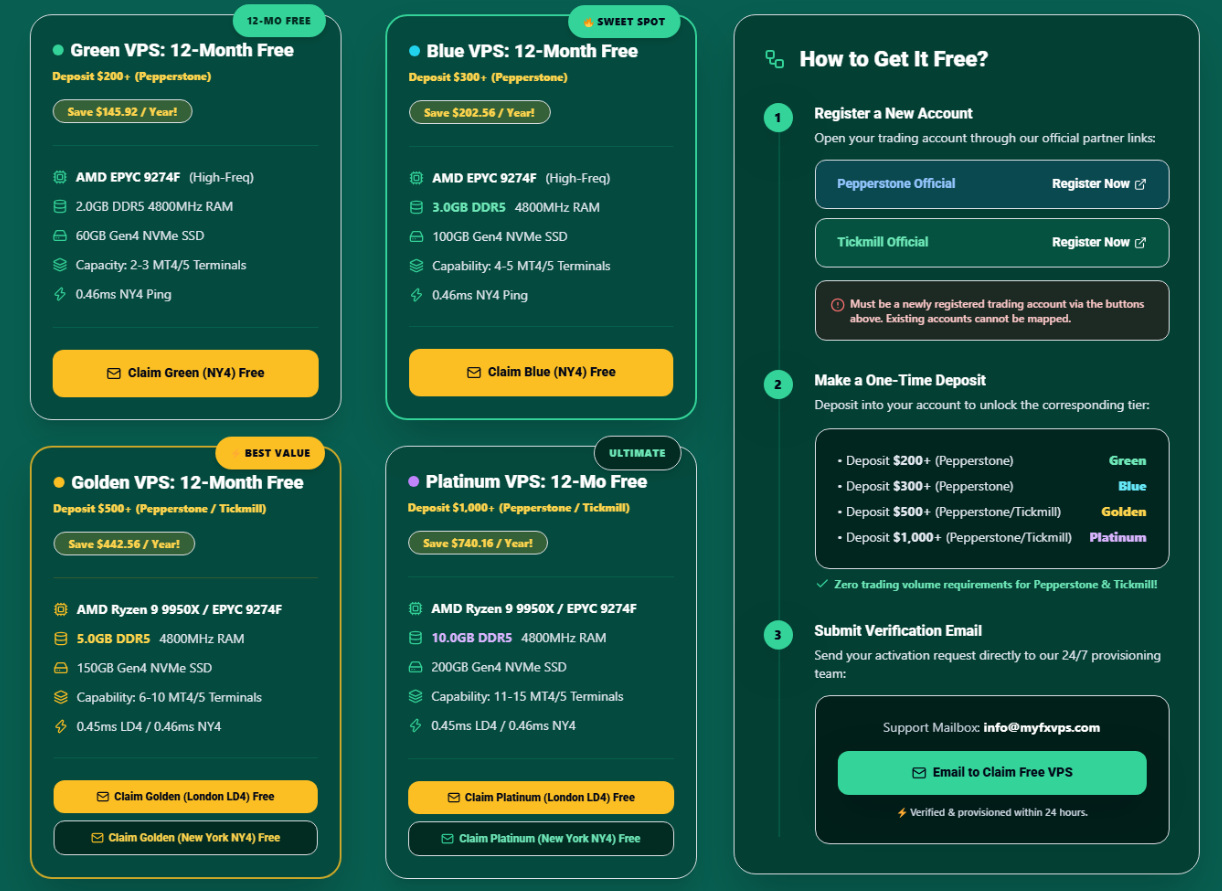
Get a premium, zero-overbooked VPS 100% FREE indefinitely by connecting your Pepperstone or Tickmill trading account!
🎁 Claim Your 100% Free Premium VPS Now